
 riverless cars are no longer science fiction—they're rolling off assembly lines and taking over streets, driveways, and curbsides. From self-parking Teslas to fully autonomous taxis, trucks, and delivery vehicles, these machines are quietly reshaping how we move. And what do investors say to humans? Just get out of the way—they know the machines are coming, and they're moving fast.
Political chaos, climate disasters, countless wars, and a shaky economy at home... as if life weren't complicated enough, here comes AI. Artificial intelligence—the science of machines that think, learn, and can generate new solutions on their own—is now reshaping not just technology, but human behavior itself. In subtle ways, it's reprogramming how we act, work, and even imagine our place in the world.
DRIVERLESS CARS AND HUMAN BEHAVIOR
 ake self-driving cars. Google's Waymo, GM's Cruise, Tesla, Amazon's Zoox, China's Baidu, British startup Wayve, Canada's Waabi, and fleet builders like Avride and Mozee are all vying to put autonomous vehicles on the road—some with no steering wheel or pedals at all. Lobbyists are storming legislative halls, literally changing the rules so these machines can hit the streets faster. And the drivers who'll lose their jobs? Not their problem, say financiers and AI barons. As AI advocate David Autor puts it bluntly: people get sick, take vacations, make mistakes. Machines? Straightforward. And no 401(k)s to fuss over.
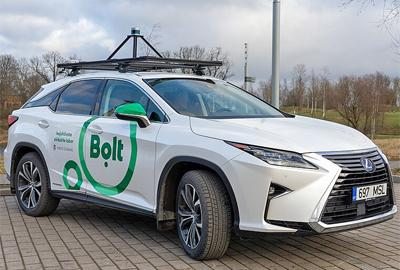
Bolt's self-driving car, photo by Alexander Corkhill
"Straightforward" can be surprising in everyday life. Last spring in Florida, my friend and I were leaving the mall, planning to walk the long way to the parking area before heading to a restaurant. Instead, she stood at the entrance curb, chatting, thinking the car would wait. A few minutes later, her Tesla Model Y—fully capable of self-parking—glided around the corner and stopped right in front of us. No human driver, no honking, just a silent robot rolling like it owned the place.
I couldn't help laughing and slightly panicking at the same time. There we were, pedestrians, and the car had decided it knew exactly where we wanted to go—better than we did. Suddenly, I realized: AI had subtly reprogrammed our behavior. We moved differently, we paused differently—we let the machine lead.
AI EDITORS AND WRITING
 rtificial intelligence doesn't just affect cars. Writing this post has been a strange mix of pride and paranoia. I'm confident in my words, but having an AI editor checking grammar, suggesting phrasing, and nudging me toward punchier sentences has made me hyper-aware of every line. On one hand, it's like a little robot proofreader who never complains, drinks your coffee, or gets tired. (ChatGPT wants to rewrite this sentence as, "It's like having a tireless robot proofreader who never spills coffee or rolls its eyes.") On the other hand... I catch myself wondering if it's subtly shaping the way I think, structure sentences, and even pick words. My writing—my voice—has become a collaboration with a machine (AI's intention: "Your words are confident, but let me help sharpen them into punchy perfection"), subtly reshaping how I think and craft each sentence. Another layer of reprogramming? (Not that human editors didn't do the same thing, just with more coffee and eye-rolling.)
WHEN AI CHANGES CAREERS
Then there's my friend who used to create life-like vector portraits using CorelDRAW, charging clients a small fortune for each piece. Back then, his skill was rare, and people paid top dollar. Nowadays? AI can produce near-perfect vector images in seconds. (Good thing fine art still needs a hand and a painstbrush—or does it?) I can't help but wonder what he's doing for a living these days. Even the most skilled, creative human labor isn't immune when machines suddenly become faster, cheaper, and tireless. Humans must rethink how they work, where they add value, and what they choose to invest their time in—another subtle nudge, another reprogramming.
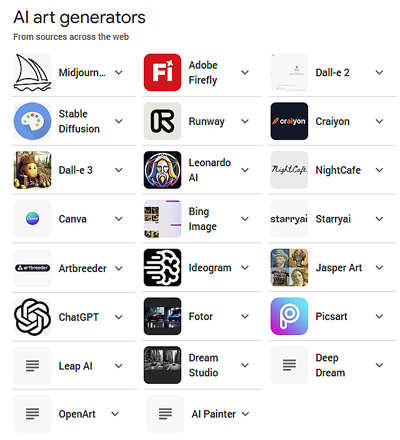
Google's search result for list of best AI generators, including Midjourney, Adobe Firefly, Dall-e, Stable Diffusion, Runway, Craiyon, Leonardo AI, NightCafe, Canva, Bing Image Creator, and ChatGPT among others.
THE SUBTLE REPROGRAMMING OF EVERYDAY LIFE
From cars that park themselves to AI that edits your writing, generates artwork, predicts trends, composes music, and even writes code, the lesson is clear: AI is not just a tool. It's a mirror and a challenge. It forces us to adapt, rethink what we do, and consider how we interact with machines daily. Step by step, task by task, habit by habit, AI is nudging, shaping, and yes—reprogramming us. We're learning, sometimes painfully, that we may need to adjust ourselves to this new world—or risk being left behind.
 his isn't just another "brave new world" headline about automation. It's the world we're already living in—one where writers, artists, workers, and honestly just about everyone else has to figure out how to move alongside machines instead of pretending they're not there. That doesn't mean surrendering what makes us human. It means staying curious, staying adaptable, and learning how to use the tools without being used by them. Because progress isn't going to slow down out of courtesy—and the sooner we learn to navigate it with our eyes open, the less likely we are to get flattened by it, figuratively or otherwise. (APJ)