
 hen a video can make someone say anything, or a portrait can generate the perfect face, how do we know what's real?
Artificial intelligence is no longer a distant tool of science fiction. From generating hyper-realistic images to producing text indistinguishable from human writing, AI is reshaping how we perceive the world. Across cinema, publishing, and social media, these technologies challenge not only our understanding of beauty and realism, but also our sense of truth itself. In a time when images, videos, and words can be fabricated with alarming accuracy, the boundary between reality and creation is increasingly difficult to see.
AI, REALISM, AND BEAUTY
AI tools like DALL·E, MidJourney, and modern deepfake systems have transformed visual media. They can produce images that are uncannily realistic or deliberately surreal, opening new creative territory while exposing uncomfortable truths. Chief among them is bias.
 rtificial intelligence systems are not neutral observers. They are trained on human-made data, and that data reflects cultural preferences and prejudices. As a result, AI often reproduces narrow ideals of beauty—favoring certain facial features, body types, and aesthetics—at scale. What once appeared as isolated cultural pressures now returns as algorithmic "objectivity."
Consider AI portrait generators that create seemingly flawless faces. The technology itself is indifferent, but the training data is not. Historical patterns of who is deemed attractive become encoded and reinforced, creating a feedback loop in which AI doesn't challenge beauty standards but amplifies them. Even in playful contexts—filters, avatars, stylized AI art—the tension between creativity and aspiration remains. Are these tools expanding expression, or quietly redefining what we believe we should look like?
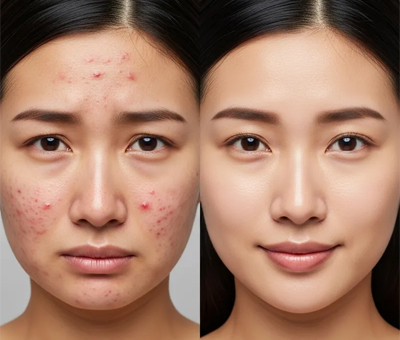
Aspirational vs. natural—illustrative AI-generated photorealistic face showing acne before and after a supposed treatment. This example highlights how "before-and-after" images in advertising and social media can be misleading. (Image source: Easy-Peasy.AI)
Not long ago, advertising campaigns and fashion magazines faced criticism for extreme retouching. Today's tools are more sophisticated, more accessible, and more pervasive—but the underlying tension remains the same. Enhancement, aspiration, and honesty are still in conflict; only the machinery has changed.
SOCIAL MEDIA AND TRUTH
 ocial platforms may be where AI's effects are felt most acutely. Synthetic voices, deepfakes, and AI-generated visuals spread rapidly, often faster than fact-checking mechanisms can respond. Algorithms prioritize engagement over accuracy, and AI-enhanced content is often designed to provoke strong reactions.
Sometimes the impact is deeply personal. I barely recognize some friends on Facebook anymore because of the filters they use in Reels. They look like manga characters—or even androids. Who, exactly, is being fooled? What appears playful also reshapes how we perceive identity, subtly distancing us from the real people behind the images. But perhaps that is their point.
There's a common Cebuano expression that captures this inversion perfectly. When something is almost too beautiful to be real, people say "murag plastik"—it looks fake. When something is perfect but synthetic, they say "murag tinood"—it looks real. Reality now borrows its credibility from the artificial, while the artificial earns praise for appearing real.
CINEMA AND TELEVISION
AI is already embedded in modern film and television production. De-aging actors, creating digital doubles, and generating background performances are increasingly common. These techniques can enhance storytelling and preserve continuity, but they also raise ethical questions.
 f performances can be altered or fabricated after the fact, what exactly are audiences responding to—the actor, the algorithm, or the studio's intent? More troubling is the potential misuse: recreating performers without consent, reshaping narratives, or blurring the line between archival footage and invention. As AI becomes more seamless, the visual language of cinema risks losing its implicit contract with the viewer.
PUBLISHING AND LITERATURE
In publishing, AI-generated text now appears in novels, poetry, marketing copy, and journalism. Some writers use AI as a collaborative tool; others reject it entirely. Newsrooms experiment cautiously while struggling with verification and accountability.
 hese developments force a reconsideration of authorship and originality. If a machine can generate coherent, persuasive prose, what defines creative labor? More importantly, what defines truth? When plausibility becomes cheap, trust becomes expensive. Readers must increasingly rely on transparency and editorial integrity rather than surface realism.
Double Standards
ociety often judges AI-generated content differently from human-manipulated content. AI-created poetry, images, or deepfake videos are frequently condemned as inherently deceptive, while comparable human interventions—editing footage, reframing events, or selectively presenting quotes—are debated in terms of intent, context, or editorial judgment.
This discrepancy is revealing. Traditional media has long shaped narratives through cuts, pacing, and emphasis, sometimes controversially. When such editorial decisions are exposed, organizations may describe them as errors in judgment or narrative framing rather than outright falsification. Yet an AI-generated version of the same manipulation would likely trigger immediate accusations of fabrication.
The difference isn't only about the act itself, but about who is perceived to be acting. Humans are granted motive, nuance, and fallibility; machines are treated as inherently suspect. These double standards highlight how trust is less about the tool and more about cultural assumptions surrounding authorship, authority, and intent.
CONCLUSION
rtificial intelligence is both a creative marvel and a destabilizing force. It reshapes what we perceive as real, beautiful, and truthful across every major media landscape. From cinema to literature to social feeds, it challenges long-held assumptions and forces us to question not just what we see, but what we value.
As AI continues to blur the line between reality and fabrication, the central question is no longer whether something can be made believable—but how we will choose what to trust, and who will be allowed to define it. (APJ—Last updated 22.Jan.2026)