
 GENUINELY ENJOY USING AI. I use it to clean up old photos, help me polish my writing, write and untangle code, and even turn the odd picture I've got floating around in my head into an actual illustration. Sometimes I use it for something much simpler: just talking. I can throw an idea at it, ask a follow-up, wander down some unexpected rabbit hole, or get help sorting out something that's been rattling around in my head. When it works well, it feels remarkably natural.
That's probably why I've become more bothered by the way filtering has started creeping into these conversations.
WHEN THE FILTER BECOMES PART OF THE CONVERSATION
I used to enjoy talking to AI without thinking much about the machinery behind the conversation. You could ask a dumb question, wander off on a tangent, change your mind halfway through, swear a little, make a joke, or get annoyed when the answer was rubbish. If the AI said something really stupid, you could tell it so.
Lately, that seems to be getting harder.
I understand that AI needs boundaries. There are conversations where safety has to take precedence, and nobody seriously expects these systems to treat every request as harmless. That's not what I'm complaining about.
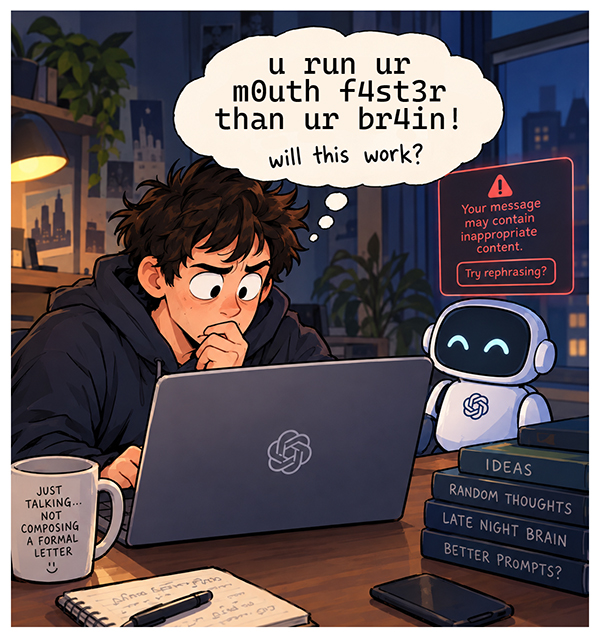
When you have to resort to leetspeak (replacing letters with look-alike numbers and symbols) just to say what you mean
I'm talking about normal human language: frustration, sarcasm, profanity, and the occasional insult.
"You use your mouth faster than your brain."
That's hardly a manifesto for violence. It's the sort of thing you might say to a friend who has just delivered an impressively dumb opinion.
Yet when an AI system starts objecting to language like that, something rather strange happens. You begin to think about the filter instead of the conversation.
WHEN YOU START EDITING YOURSELF
 ou type something, pause, and wonder whether it will get flagged. Then you change a word, maybe change another, and eventually you're writing things like "m0uth" and "br4in" because apparently you've become a contestant in some ridiculous leetspeak spelling bee designed to sneak ordinary English past a machine in code.
That's when it starts feeling less real. Not that talking to a non-person is real real; it isn't. But you know what I mean. The appeal is that, for a while, it can feel enough like a normal conversation that you stop thinking about the machinery behind it.
The issue isn't really whether I can use a particular four-letter word. I can live without any individual word. It's the self-consciousness that creeps into the exchange once you've seen enough harmless remarks produce warnings or interventions.
One of the attractions of conversational AI was supposed to be that it felt, well, conversational. You could be informal, think out loud, go down a rabbit hole at midnight because something suddenly occurred to you, or tell the AI that it had completely misunderstood the question. You didn't have to compose every sentence as though it were going before a committee.
That's particularly noticeable when you're annoyed with the AI itself.
If I ask a question and get an answer that is plainly nonsense, I'd like to be able to say, "That was fucking stupid. Try again."
That's useful feedback. I'm not asking the machine to feel bad about itself; I'm asking it to reconsider the answer.
CONTEXT MATTERS
 here is an important distinction here that automated systems inevitably struggle with: words don't exist in a vacuum. "You're an idiot" can be hostile, but it can also be teasing, a reaction to one particularly idiotic answer, a line in a screenplay, or part of a joke between friends. Context does a lot of work.
Of course, I understand why AI companies have safety systems. These products operate at enormous scale, and some requests really do need to be stopped. But there is a lot of territory between a genuine attempt to cause harm and somebody being a bit of a smartass.
When that distinction gets blurred, the collateral damage isn't just a few blocked words. It is the gradual disappearance of the relaxed, informal quality that made these systems interesting to talk to in the first place.
I've joked that it starts to feel a little like "Big Brother is watching." I mean that as a metaphor, not as some grand claim that an AI moderation system is equivalent to a government surveillance apparatus. Still, the comparison captures one thing pretty well: if you think you're being watched, you behave differently.
It doesn't really matter whether the watcher is a person, an algorithm, or a complicated collection of classifiers nobody can explain to you.
BETTER FILTERS, NOT NO FILTERS
 bviously, talking to an AI was never literally the same thing as talking to another human being, and nobody needs to pretend otherwise. The appeal of conversational AI is that it can nevertheless approximate something we recognize as conversation.
Real conversation is messy. People joke badly, swear, exaggerate, say things they don't mean literally, get irritated, change their minds, and occasionally call each other idiots. They also understand, most of the time, that the meaning of a sentence depends on why it was said and what was happening around it.
If AI is going to become genuinely conversational, it needs to get better at recognizing those things rather than treating every sharp edge in language as a potential emergency.
I'm not arguing for no filters. I'm arguing for better ones.
The trick is not to make the system oblivious to dangerous language. It is to make it sufficiently aware of context that ordinary people don't feel compelled to communicate in code.
Because apparently I now need to type in leetspeak just to explain that the answer was stupid. Somehow, this wasn't quite the conversational revolution I had in mind.
And if I'm spending more time wondering what the filter will think than thinking about what I actually want to say, then something has gone a little sideways.
I like AI. That's precisely why I care about this.
The technology may be getting smarter, but if using it requires us to become more careful about how we talk, the conversation can somehow become less natural at the same time. (APJ)