
HOW A HUMBLE GROCERY BAG WENT FROM MERE PRACTICAL AFTERTHOUGHT TO ONE BIG CULTURAL MOMENT — WITHOUT TRADER JOE'S LIFTING A FINGER
 OULD YOU GRAB ME SOME TRADER JOE'S TOTE BAGS, HON—as many as the store will let us? Just in case."
That's what my wife said, casually, as if she were asking me to pick up milk. I paused. Not because I didn't understand the words, but because I didn't understand the why. We already had a perfectly good bag: a sturdy, classic beige tote. We used it all the time—groceries, frozen stuff, perishables. It did its job quietly and well.
THE FIRST HINT
"So... Why?" I asked.
She smiled, not in a mischievous way, just matter-of-fact. She wasn't planning to flip them online or start a side hustle. She was thinking ahead—future use, backups for when the old ones wore out, small tokens to hand to visiting friends, maybe little gifts for family, or homecoming presents perhaps. A stash, a quiet little army of totes ready for whatever came next. Why have one when you can have several?
THE INTERNET NOTICE
That was my first hint that the humble Trader Joe's tote had somehow become more.
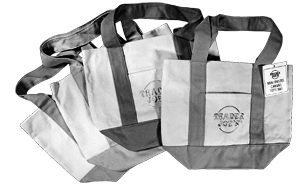 What really threw me was that this was happening in the same universe where one of my prized bag purchases had made absolutely zero impact. A while back, I scored a Fred Perry man tote on sale. Clean lines, tasteful branding, objectively nicer than a grocery bag. I carried it around a few times, half-expecting it might at least register with someone. It didn't. Not a glance. Not a comment. The bag might as well have been invisible.
 nd yet here we were, discussing the strategic acquisition of grocery totes.
THE CULT PHENOMENON
The beige Trader Joe's tote we already owned was nothing special to look at—and that's kind of the point. It worked. It always had. But somewhere along the way, Trader Joe's released mini canvas totes in pastel colors, and the internet noticed. 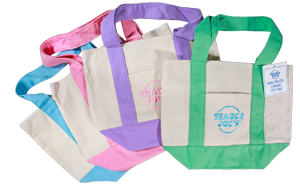 Pink, mint, purple, yellow. Small, cheerful, easy to photograph. Suddenly, these bags weren't just for carrying groceries and what-not. They were being styled with outfits, carefully arranged for snapshots, collected like tiny trophies, color-coordinated, and posted across social media feeds. The humble tote had transformed into a miniature cultural moment.
THE PASTELS VS. BEIGE
Like other cult phenomena, these totes started cheap, functional, and unassuming—then the internet turned them into must-have collectibles. For prices that make you blink.
People lined up for them. People bought as many as they were allowed. People paid real money—not $2.99, but $20, $100, even hundreds—on resale sites for sets of them.
TRADER JOE'S DID NOTHING
 rader Joe's, for its part, did absolutely nothing to promote this. No ads. No influencer campaigns. No limited drops teased in advance. Just bags on a shelf. The rest was handled by shoppers and algorithms. A perfect storm of timing, aesthetics, and social media hype turned a basic canvas tote into a viral phenomenon.
Meanwhile, our beige tote stayed exactly what it had always been: practical, unnoticed, and extremely good at its job. Even those occasionally show up on resale platforms—sometimes even in Europe, where Trader Joe's doesn't exist—but at modest prices. They're curiosities, not trophies. The real frenzy belongs to the pastel minis.
THE PARIS CONNECTION
 hat makes all this even funnier is that none of it was entirely new. A few years ago, plain canvas totes were quietly everywhere in Paris. No logos, no flash—just simple, utilitarian bags carried to markets and cafés. My wife followed that trend religiously, even though she'd been using canvas totes in New York long before Paris decided they were chic. She didn't change her habits; the world just caught up for a while.
Seen that way, the Trader Joe's mini tote feels like the loud, internet-age descendant of that same idea. Same bones, different energy. One whispers "practical," the other screams "limited edition."
THE REAL WINNER
 he real winner in all of this is Trader Joe's. For the cost of a few dollars per bag, they've ended up with free, global advertising. Every grocery run, every travel photo, every casual street shot becomes a tiny billboard. Shoppers do the marketing. TJ just keeps selling groceries. They've already dabbled in soaps, lip balm, and household stuff—but honestly, a line (and even a dedicated shop) of utilitarian-fashion items, maybe more chic canvas bags and practical everyday gear, wouldn't feel too far-fetched.
HOW WE USE OUR TOTES
s for us, we still use the beige tote the same way we always have. Groceries in, groceries out. The Fred Perry tote still exists, still nice, still mostly unnoticed. And the pastel minis? They'll keep circulating, collecting likes, crossing borders, and confusing people who just wanted a bag to carry food.
Sometimes a tote becomes a cultural phenomenon. Sometimes it just carries your groceries. And honestly, both outcomes are fine.
POSTSCRIPT
Somebody actually listed a classic beige-and-blue TJ tote for $50,000 on eBay. I'm not fussing—it probably won't sell. (APJ)