
Rethinking tennis rankings in an era when being No. 1 doesn't necessarily mean dominating the court.
 'VE ALWAYS WONDERED ABOUT THE DISPARITY BETWEEN THE CONSISTENCY OF ACHIEVEMENT AND RANKINGS OF PLAYERS from tennis's earlier generations and what we see today.
There seems to be an increasingly haphazard, disconnected and inconsistent pattern of performances among today's professional players. Players rise to the top of the rankings, only to suffer unexpected early exits in tournaments where you'd expect them to dominate. Being world No. 1 doesn't always seem to reflect genuine dominance on the court.
Compare that with the remarkable consistency of champions from previous generations. Players such as Graf, Laver and Sampras built records that seemed to offer a much clearer connection between their rankings, their tournament victories and their standing in the sport.
Of course, no generation is without its surprises, unexpected defeats and extraordinary rivalries. Nor does consistency alone tell the whole story. But it does raise a question worth considering: have we become so preoccupied with accumulating ranking points that we've lost sight of what those rankings are supposed to represent in the first place?
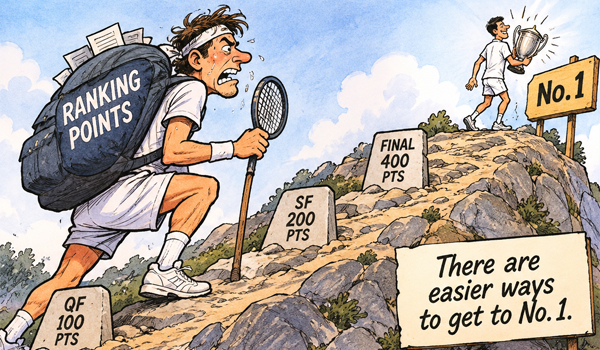
When climbing the rankings becomes an endurance test in mathematics, consistency can sometimes matter more than actually lifting the trophy. Perhaps tennis needs a simpler definition of success.
WHAT TENNIS PLAYERS THINK ABOUT THE CURRENT RANKING SYSTEM
Several professional players have voiced concerns about the current ranking systems, particularly regarding scheduling, fairness and the pressure to compete.
Not all these criticisms concern the same aspects of the ranking system. Some relate to the ongoing pressure of tournament participation and scheduling, while others arose from the exceptional ranking adjustments introduced during the COVID-19 pandemic.
- DANIIL MEDVEDEV (2026) — Has suggested simplifying the ranking structure by concentrating points on Grand Slams and Masters 1000 tournaments.
- CASPER RUUD (2025) — Has criticised the pressure to compete constantly and defend ranking points, even when players are injured or need rest.
- JESSICA PEGULA (2026) — Has supported discussions about reforming the WTA, including tournament scheduling, mandatory participation and ranking-point allocation.
- ALEXANDER ZVEREV and ANDREY RUBLEV (2021) — Questioned the fairness of the pandemic-adjusted ranking system, arguing that it did not accurately reflect current performance.
- HOLGER RUNE (2021) — Raised concerns that the adjusted system disadvantaged younger players trying to break into the top rankings.
These criticisms highlight a recurring question in professional tennis: does the current ranking system truly reward sporting achievement, or does it also reward availability, participation and accumulated points?
Perhaps it's time to take a fresh look at how professional tennis measures achievement. What if ranking points were awarded exclusively for winning tournaments? What if those points never expired, allowing a player's entire collection of titles to count towards their standing? And what if the world's No. 1 genuinely represented the player with the greatest accumulated record of championship victories?
These questions led me to consider an alternative to the existing ranking systems, one built around a simple principle: winning should count above everything else.
I call it the True Tennis Test, or Triple-T (TTT).
FOUR TOURNAMENT CATEGORIES. THREE SPECIAL ACHIEVEMENT AWARDS.
The scoring system is deliberately straightforward. Each tournament category carries a fixed points value, awarded exclusively to the champion:
| Tournament | Champion's points |
|---|---|
| Grand Slam | 2.00 |
| Masters 1000 | 1.00 |
| ATP/WTA 500 | 0.50 |
| ATP/WTA 250 | 0.25 |
There are no points for reaching a final, making the semifinals or putting together a respectable run to the quarterfinals. Those are achievements in their own right, but they don't make you the tournament champion. Under Triple-T, the points go to the player who wins.
The relative values are just as easy to understand: one Grand Slam title is worth two Masters 1000 titles, four ATP/WTA 500 titles or eight ATP/WTA 250 titles. Every category has a clearly defined value, with no complicated calculations, weighting formulas or points tables to decipher.
The idea is to keep things transparent. Anyone should be able to look at a player's collection of titles, calculate their points and understand exactly where they stand. After all, if a ranking system is supposed to measure achievement, why should it take a spreadsheet to figure it out?
THE EXTRAORDINARY BONUS: OLYMPIC GOLD, CALENDAR-YEAR GRAND SLAM & CALENDAR-YEAR GOLDEN GRAND SLAM
Some achievements stand above even the greatest tournament victories. Winning an Olympic singles gold medal is one of them, deserving a standalone bonus of 5.00 points.
But completing all four Grand Slam tournaments in a single calendar year is an even rarer accomplishment. It demands exceptional dominance, consistency and mental toughness, as well as the ability to win on four different surfaces under very different conditions. Triple-T recognises this with an additional 10.00-point Calendar-Year Grand Slam bonus.
And for the extraordinary player who achieves both feats in the same calendar year, there is the ultimate distinction: the Calendar-Year Golden Grand Slam, worth 15.00 bonus points in total, replacing the two individual bonuses rather than adding to them.
| Achievement | Points |
|---|---|
| Olympic Gold | 5.00 |
| Calendar-Year Grand Slam bonus | 10.00 |
| Calendar-Year Golden Grand Slam bonus | 15.00 |
These bonuses are not cumulative. If a player achieves the Calendar-Year Golden Grand Slam by winning all four Grand Slam titles and Olympic gold in the same calendar year, the 15.00-point Calendar-Year Golden Grand Slam bonus replaces the individual Olympic Gold (5.00) and Calendar-Year Grand Slam (10.00) bonuses. Only the 15.00 points are awarded.
HOW DOES TRIPLE-T DIFFER FROM THE EXISTING RANKING SYSTEM?
The difference between the traditional ATP/WTA rankings and Triple-T is fundamental. While the existing systems award points for progressing through tournament rounds, Triple-T rewards only the ultimate achievement: winning the championship.
The following comparison highlights the two very different philosophies.
| Feature | ATP/WTA | Triple-T |
|---|---|---|
| Tournament champion | Points | Points |
| Runner-up | Points | Zero |
| Semifinalist | Points | Zero |
| Quarterfinalist | Points | Zero |
| Points expiration | 52 weeks | Never |
| Career achievements retained | No | Yes |
| Calendar-Year Grand Slam recognition | No equivalent | 10-point bonus |
| Permanent Hall of Fame ranking | No | Yes |
| Men's and women's scoring formula | Different structures | Identical |
Olympic singles gold carries a standalone award of 5.00 points. However, when a player achieves the Calendar-Year Golden Grand Slam, the standalone Olympic Gold points and the 10.00-point Calendar-Year Grand Slam bonus are both replaced by the single 15.00-point Calendar-Year Golden Grand Slam bonus. The bonuses are not cumulative.
The distinction is important: the bonus applies only when all four Grand Slam titles are won within the same calendar year.
Tennis history provides some remarkable examples. Rod Laver completed the Calendar-Year Grand Slam twice, in 1962 and 1969; under the Open Era methodology used here, only his 1969 achievement qualifies for the 10.00-point bonus. Steffi Graf achieved the same feat in 1988, while Margaret Court accomplished it in 1970, each earning an additional 10.00 points.
Graf's achievement, however, went one step further. In 1988, she also won Olympic singles gold in Seoul, completing what is known as the Golden Grand Slam. This is where Triple-T introduces an additional distinction, recognising the combination of all four major titles and Olympic gold in the same year with a 15.00-point Golden Grand Slam bonus.
Winning four Grand Slam titles over a career is remarkable. Winning all four in the same year is an entirely different achievement. Add Olympic gold to the equation, and the accomplishment becomes even more extraordinary. Triple-T is designed to recognise these distinctions rather than treat every collection of titles as equivalent.
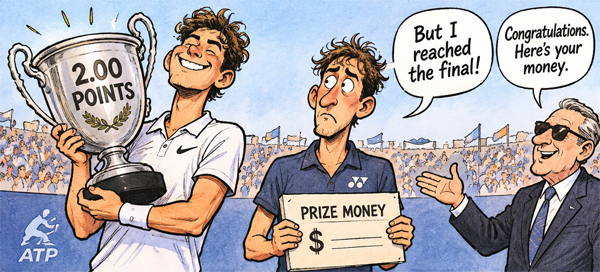
In the theoretical Triple-T ranking game, reaching the final may earn you a handsome payday, but only winning gets you the points. Supposedly, second place is just a financial achievement.
PLAY WELL, EARN MONEY. WIN, EARN POINTS.
Before the players start protesting, let's get one thing straight: Triple-T has no intention of taking away prize money from players who don't win.
Tournament prize money would continue to be distributed according to the existing arrangements. Reach the final and you collect your runner-up cheque. Make the semifinals and you receive the prize money allocated to that round. Even a first-round exit comes with the compensation applicable to that stage of the tournament.
The distinction between financial compensation and sporting recognition is fundamental.
Players would retain their financial incentive to compete, progress through tournaments and perform to the best of their ability. The difference is that ranking points would be reserved exclusively for the ultimate achievement: winning the tournament.
After all, if a tournament has produced a champion, why should the runner-up receive ranking points simply for losing the final?
The principle is simple: Champions earn points. Everyone else earns just the money.
AND HERE'S THE RADICAL PART: POINTS NEVER EXPIRE.
Under the existing ranking systems, players must continually defend points earned during the corresponding period of the previous year. In effect, a successful season can become a burden twelve months later, with players having to repeat their achievements simply to maintain their ranking.
Triple-T does away with that entire concept.
Every tournament victory is permanently recorded. A Grand Slam title earned today remains worth 2.00 points tomorrow, next year and twenty years from now. There are no expiration dates, no points to defend and no sudden ranking drops simply because previous results have fallen outside a rolling 52-week window.
Instead, a player's career becomes a cumulative record of championship achievements. You start at zero, add points whenever you win a qualifying tournament and retain everything you've earned throughout your career.
And yes, under this system, a player could theoretically spend an entire professional career without winning a qualifying tournament and retire with precisely zero ranking points.
Harsh? Perhaps. But ranking points are supposed to recognise achievement, not participation.
ONE ACTIVE RANKING. ONE HALL OF FAME.
Triple-T would maintain two separate leaderboards, both calculated using exactly the same scoring formula.
The Active World Ranking
All active professional players would be ranked according to their accumulated career points. Every qualifying tournament victory would add to their total, with points remaining on their record for as long as they compete.
No rolling 52-week window, no annual reset and no points to defend. Just a running total of career achievements.
The Hall of Fame Ranking
Upon retirement, a player's accumulated points would be transferred to the Hall of Fame leaderboard, preserving their career achievements and final position within the system.
There would be no separate historical scoring formula, no special treatment for famous names and no adjustments simply because a player belongs to a different generation.
Whether you're an active player or a retired champion, the same rules apply. The mathematics never changes.
WHAT WOULD THIS MEAN FOR THE LEGENDS?
Consider some of the greatest champions the sport has produced. Pete Sampras won 14 Grand Slam singles titles, Roger Federer 20, Rafael Nadal 22 and Novak Djokovic 24.
These numbers represent far more than impressive statistics. Each title is the result of winning an entire tournament against some of the strongest competition in professional tennis.
Triple-T would recognise every one of those victories directly, while also taking account of Masters 1000, ATP/WTA 500 and ATP/WTA 250 titles. The result would be a ranking built around the trophies players have actually won throughout their careers.
It would also provide an interesting way to compare champions across generations, provided historical tournament categories and their corresponding points values are properly standardised.
Imagine a Hall of Fame leaderboard bringing together the greatest champions in tennis history, all measured against exactly the same scoring formula. That would certainly give tennis fans something to argue about!
SO, WHAT WOULD THE TRIPLE-T RANKINGS LOOK LIKE?
Enough theory. Let's put Triple-T to the test and see how some of tennis's greatest champions might fare under the proposed system.
Using available Open Era tournament records, I've put together illustrative top-five leaderboards for men's and women's tennis, covering both retired champions and currently active players.
The results offer an interesting glimpse of how a ranking system based exclusively on tournament victories, with points accumulated permanently throughout a career, could reshape the tennis hierarchy.
There are four leaderboards to explore:
MEN'S HALL OF FAME — OPEN ERA
| Player | GS | M1000 | 500 | 250 | Olympic | Bonus | Total |
|---|---|---|---|---|---|---|---|
| Rafael Nadal | 22 | 36 | 23 | 10 | 1 | 0.00 | 99.00 |
| Roger Federer | 20 | 28 | 24 | 25 | 0 | 0.00 | 86.25 |
| Pete Sampras | 14 | 11 | 12 | 20 | 0 | 0.00 | 50.00 |
| Jimmy Connors | 8 | 0 | 0 | 100 | 0 | 0.00 | 41.00 |
| Ivan Lendl | 8 | 0 | 17 | 63 | 0 | 0.00 | 40.25 |
WOMEN'S HALL OF FAME — OPEN ERA
| Player | GS | W1000 | 500 | 250 | Olympic | Bonus | Total |
|---|---|---|---|---|---|---|---|
| Steffi Graf | 22 | 15 | 36 | 28 | 1* | 15.00 | 99.00 |
| Martina Navratilova | 18 | 3 | 51 | 87 | 0 | 0.00 | 86.25 |
| Chris Evert | 18 | 0 | 19 | 112 | 0 | 0.00 | 73.50 |
| Margaret Court | 11 | 0 | 4 | 78 | 0 | 10.00 | 53.50 |
| Monica Seles | 9 | 9 | 21 | 11 | 0 | 0.00 | 40.25 |
* Olympic gold medal awarded, but its standalone 5.00 points are absorbed into the 15.00-point Golden Grand Slam bonus. No double-counting applies.
These are the leading retired-player candidates by historical title records, not a verified final Triple-T ordering.
MEN'S ACTIVE WORLD RANKING
| Player | GS | M1000 | 500 | 250 | Olympic | Bonus | Total |
|---|---|---|---|---|---|---|---|
| Novak Djokovic | 24 | 40 | 16 | 14 | 1 | 0.00 | 104.50 |
| Carlos Alcaraz | 7 | 8 | 11 | 2 | 0 | 0.00 | 28.00 |
| Jannik Sinner | 5 | 10 | 7 | 6 | 0 | 0.00 | 25.00 |
| Alexander Zverev | 2 | 7 | 6 | 8 | 1 | 0.00 | 21.00 |
| Daniil Medvedev | 1 | 6 | 5 | 12 | 0 | 0.00 | 13.50 |
WOMEN'S ACTIVE WORLD RANKING
| Player | GS | W1000 | 500 | 250 | Olympic | Bonus | Total |
|---|---|---|---|---|---|---|---|
| Iga Swiatek | 6 | 12 | 7 | 1 | 0 | 0 | 27.75 |
| Venus Williams | 7 | 9 | 1 | 5 | 0 | 0 | 24.75 |
| Aryna Sabalenka | 4 | 11 | 6 | 2 | 0 | 0 | 22.50 |
| Elena Rybakina | 3 | 2 | 7 | 2 | 0 | 0 | 12.00 |
| Elina Svitolina | 0 | 5 | 2 | 12 | 0 | 0 | 9.00 |
Important Disclaimer: These are illustrative, theoretical Triple-T rankings, presented for demonstration purposes only. Although based on available historical tournament records and category classifications, the underlying title counts, historical equivalents and point allocations have not all been independently verified. Consequently, the rankings and totals are provisional and may change following further research, verification and validation.
Additional Information
- All four lists cover the Open Era (1968 onwards).
- Only singles tournament victories are included. Doubles and mixed doubles titles are excluded.
- GS = Grand Slam; M1000/W1000 = Masters 1000 equivalent.
- Olympic points apply exclusively to singles gold medals. Silver and bronze medals earn no points.
- Calendar-Year Grand Slam bonus: 10.00 points.
- Calendar-Year Golden Grand Slam bonus: 15.00 points, replacing the separate Olympic Gold and Calendar-Year Grand Slam bonuses. The bonuses are not cumulative.
- ATP/WTA Finals titles are excluded because they have not been assigned a separate value under the proposed scoring structure.
- Historical tournament classifications: For the purposes of this illustrative ranking, historical tournament titles have been assigned to their corresponding modern tour categories wherever a reasonable equivalent exists. These classifications are intended as a consistent comparison framework rather than a definitive reconstruction of every historical tour structure.
- Active rankings are based on accumulated career points, not the existing rolling 52-week ranking system.
- Hall of Fame rankings include retired players, whose accumulated points remain permanently recorded.
- Rod Laver's 1962 Calendar-Year Grand Slam predates the Open Era and is therefore excluded. His 1969 Calendar-Year Grand Slam qualifies for the 10.00-point Triple-T bonus.
- Active rankings reflect players competing as of November 4, 2026.
BUT WOULDN'T THE PLAYERS REVOLT?
Quite possibly!
Imagine telling a player who has reached six consecutive Masters semifinals that those appearances have earned precisely zero ranking points. Or explaining to a runner-up that his opponent has collected 1.00 point while he walks away with nothing from a ranking perspective.
There would undoubtedly be some lively discussions in the ATP and WTA locker rooms.
But players would still receive their prize money, retain their sponsorship arrangements and have every financial incentive to compete. Triple-T isn't intended to undermine their livelihoods or diminish the value of reaching the latter stages of a tournament. It simply separates financial rewards from the recognition of championship achievement.
That said, there are legitimate questions that any serious alternative ranking system must address. How would it affect tournament participation? Would injuries and career interruptions create additional disadvantages? How should older tournaments be classified to ensure fair comparisons across generations?
Perhaps the biggest concern is whether the world's top players might choose to compete less frequently, knowing that anything short of a tournament victory contributes nothing to their ranking. That's a genuine possibility and one that deserves careful consideration.
These are not insignificant issues, and Triple-T would need to address them before it could become a practical alternative to the existing systems. But they shouldn't prevent us from questioning whether the way tennis currently measures achievement is necessarily the only way, or even the most meaningful way.
A RANKING SHOULD MEAN SOMETHING.
 ennis has given us some extraordinary champions: Rod Laver, Björn Borg, John McEnroe, Steffi Graf, Martina Navratilova, Pete Sampras, Serena Williams, Roger Federer, Rafael Nadal and Novak Djokovic, to name just a few.
What made these players special wasn't simply their ability to turn up week after week and accumulate ranking points. It was their ability to win, and to keep winning, against the very best in the sport.
They won.
Sometimes spectacularly, sometimes against seemingly impossible odds, but always leaving behind a collection of titles that defined their careers and shaped tennis history.
And a select few went even further, achieving something that very few players in the history of the sport have managed: winning all four Grand Slam tournaments in the same calendar year.
Surely achievements of that magnitude deserve to be reflected more clearly in the way we rank and compare players.
Triple-T is admittedly a radical proposal. It would require significant changes to the existing professional tennis structures, and it certainly wouldn't please everyone. But its underlying principle is straightforward: a ranking should reflect what a player has actually won, not simply how many ranking points they've accumulated along the way.
Champions earn points. Everyone else earns just the money.
No consolation points, no expiring points and no complicated calculations. Just a straightforward measure of championship achievement, with additional recognition for the most extraordinary accomplishments in the sport.
After all, isn't that what professional tennis is ultimately about?
Welcome to Triple-T—where winning isn't just everything. It's what counts. (APJ)