
 HERE WAS A TIME WHEN HARRY AND MEGHAN MATTERED. They mattered as a rupture in the modern monarchy, a challenge to royal media norms, and a test case for cross-continental celebrity activism in the digital age.
That time has passed. What remains in its wake is something stranger, even sadder: relevance without consequence, visibility without impact, and influence with no lasting value.
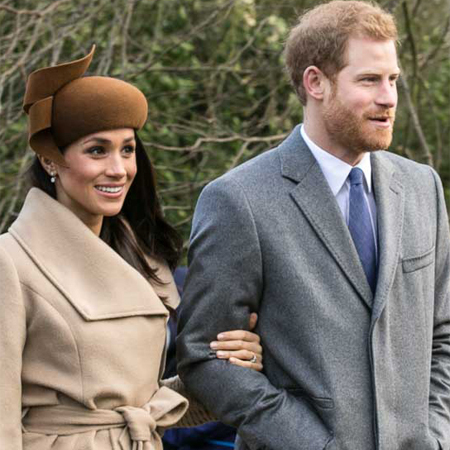
Photo of Prince Harry and Meghan Markle going to church at Sandringham on Christmas Day 2017 by Mark Jones, cropped/edited from the original on Flickr, licensed under Creative Commons Attribution 2.0.
Harry and Meghan now exist in a cultural limbo—no longer central figures, yet stubbornly omnipresent. They don't shape policy. They don't steer the monarchy. They don't meaningfully alter public debate. And yet they keep appearing in headlines, lawsuits, polls, documentaries, and opinion columns as if something decisive were still at stake.
ATTENTION WITHOUT GRAVITY
 ost people feel neither love nor hate for them anymore. Polling in the UK shows low favorability for both, yet disapproval still implies engagement. What's more corrosive is indifference paired with exhaustion.
So why the coverage? Because Harry and Meghan sit at a profitable intersection: royalty, celebrity grievance, media ethics, culture-war symbolism, and high-profile victimhood. Editors don't need them to do anything—only to be something. They are endlessly repurposable avatars: targets of the press, destroyers of tradition, champions of mental health, or hypocrites of privilege. Choose your angle; the template already exists.
This is not influence. It's content inertia.
THE LAWSUIT LOOP
Prince Harry's ongoing legal battle against the British press illustrates the paradox perfectly. His complaints about intrusion are not new; the allegations themselves are years old. What's new is the repetition. Each court appearance revives the same arguments, framed as a showdown between truth and tabloids.
But these cases no longer advance the conversation about press ethics. They recycle it. Even supporters struggle to articulate what victory would meaningfully change, beyond symbolic vindication. The story persists not because it evolves, but because it reliably generates outrage, defense, and clicks. Ironically, the media benefits from the conflict it's accused of perpetuating.
IRRELEVANCE AS A FEATURE
 he monarchy has moved on. The line of succession is stable. But perhaps this is the deeper irony: in an era when relevance is earned, not inherited, one has to wonder whether the institution itself still serves a purpose beyond ceremony. Its challenges—public trust, generational legitimacy, and relevance in a pluralistic society—exist independently of the Sussexes. In this light, Harry and Meghan are no longer a threat or a catalyst; they're background noise, revealing how little depends on them—and maybe how little depends on the monarchy itself.
Yet that noise is amplified because it's safe. Covering them requires no investigative risk, no structural critique, no new thinking. It's familiar drama with prewritten roles. Even backlash is monetizable. Indifference is not.
CELEBRITY WITHOUT DIRECTION
Photo of Prince Harry and Meghan Markle going to church at Sandringham on Christmas Day 2017 by Mark Jones, cropped/edited from the original on Flickr, licensed under Creative Commons Attribution 2.0.
Their post-royal projects reflect the same drift. Media deals arrive with fanfare and dissolve quietly. Messaging oscillates between moral urgency and lifestyle branding. Causes blur into content. Nothing lands with the force it once promised.
That doesn't make them villains. It makes them symptomatic. They are a case study in late-stage celebrity culture, where attention outlives purpose and narrative substitutes for action. Where being talked about is mistaken for mattering.
The Quiet Verdict
 istory rarely ends stories with explosions. More often, it ends them with diminishing returns. Harry and Meghan won't be formally exiled or dramatically redeemed. They'll simply persist in headlines long after the public has stopped listening closely—neither disgraced nor triumphant, just... there./p>
And perhaps that's the real lesson—not about the masses, monarchy, or media, but about a culture that keeps feeding figures who no longer nourish it.
The Sussex saga isn't infuriating because it's offensive. It's infuriating because it's unnecessary—a story amplified only by a culture that still treats the monarchy as essential, when perhaps its true relevance has quietly faded along with the figures it once revolved around. (APJ)