
 N TENNIS, GREATNESS IS ONE THING. Making history is another.
Winning a Grand Slam is hard enough. Winning all four majors in the same calendar year? That's a different beast altogether. Different surfaces, different conditions, different pressures—and no room for a bad fortnight. Just when you've figured out one tournament, the next one asks a completely different question.
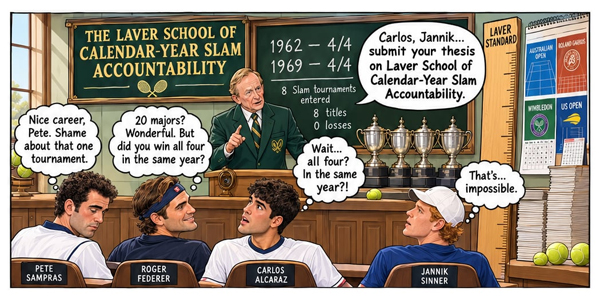
Welcome to the (fictional) Laver School of Calendar-Year Slam Accountability, where even the greatest champions face a four-major exam. Rod Laver passed it in 1962 and 1969. Pete Sampras, Roger Federer, Carlos Alcaraz, and Jannik Sinner are left wondering just how anyone manages to win all four Grand Slams in a single calendar year.
That's what makes the achievement so fascinating. The margins are tiny, but the obstacles are enormous. A dodgy day, an awkward matchup, an injury at the wrong moment, or an opponent who simply refuses to go away can derail an entire season's dream. You can be the best player in the world and still fall short.
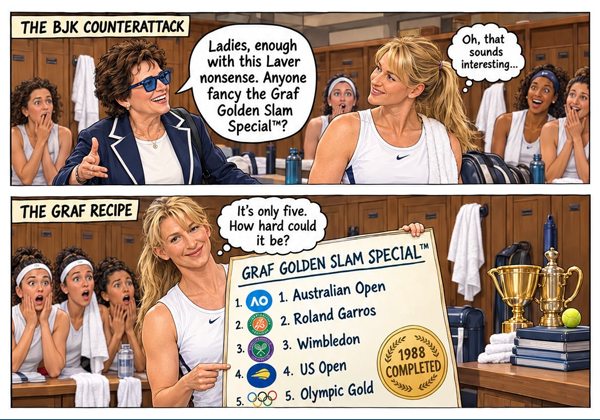
The recipe for greatness? Billie Jean King recommends Steffi Graf's 1988 Golden Slam, which combined all four major titles with Olympic gold. This satirical tennis comic imagines the recipe being presented to a skeptical room of players, with a playful nod to the standards applied to different champions.
Rod Laver showed just how extraordinary it can be, completing the calendar-year Grand Slam twice, in 1962 and 1969. That alone tells you something about the scale of the challenge. And then there's Steffi Graf, who went one step further in a different way in 1988, winning all four majors AND an Olympic singles gold. Five titles, one remarkable year.
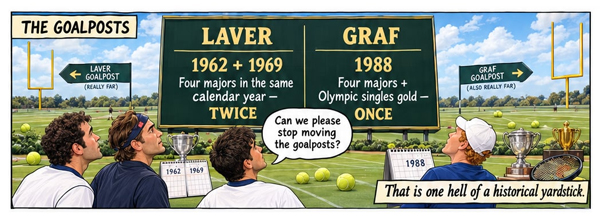
The goalposts keep moving: a tongue-in-cheek look at the debate over calendar-year Grand Slams, as Rod Laver's 1962 and 1969 achievements face off against Steffi Graf's historic 1988 season, which included an Olympic gold.
 he comic strip gets at the fun of comparing these achievements, but the bigger point is that tennis history isn't a simple scoreboard. Different eras bring different challenges, and records don't always fit neatly into a single ranking of greatness. The goalposts may move, but the difficulty doesn't disappear.
Perhaps that's why the calendar-year Grand Slam still carries such a mythical quality. Plenty of champions have dominated a season, collected multiple majors and looked practically untouchable. Very few have managed to put all the pieces together when it mattered most.
And that's the beauty of it. The Grand Slam isn't just about being brilliant for two weeks. It's about staying brilliant, staying healthy and surviving everything four major tournaments can throw at you—for an entire year. Easy enough on paper. Just ask anyone who's tried. (APJ)