
 EW YORK HAS A REPUTATION FOR VOLUME. Noise, scale, urgency. It's a city that doesn't wait for you to catch up, and most people experience it exactly that way—loud intersections, packed trains, sidewalks that feel like conveyor belts.
But that version of New York isn't the whole city. It's just the surface layer.
If you move through it slowly enough, or sideways instead of forward, the city starts to reveal its quieter rooms. Not hidden gems. Not secrets. Just places that were never trying to be loud in the first place.
SYLVAN TERRACE
 omewhere above Harlem, tucked behind a museum most people rush through, there's a short wooden street called Sylvan Terrace. Sixteen identical yellow houses line a narrow path that looks like it belongs to another century—or another city entirely.
It's quiet in a way that feels intentional, almost protected. The city hum drops a few notches, like someone turned down the gain. You don't linger long there. You just stand, absorb the fact that this exists, and move on.
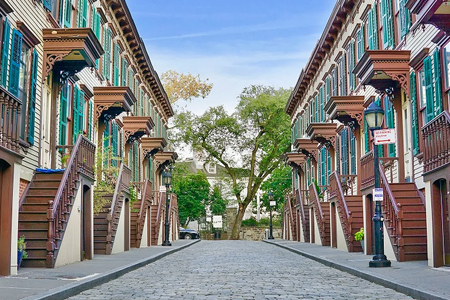
Sylvan Terrace, a historic grouping of 20 three-story, wood-framed townhouses within the Jumel Terrace Historic District in Washington Heights, Manhattan, is sometimes erroneously known as Sylvan Place.
POMANDER WALK
 n the Upper West Side, there's Pomander Walk. You can't walk through it—just peer in through the gates—but even that feels like enough.
Tudor-style homes, tightly arranged, frozen in a different architectural mood than the rest of Manhattan. It's less about access and more about contrast. One step away is traffic and scaffolding; one glance inside is order, symmetry, quiet domesticity. A reminder that New York has always been many cities stacked on top of each other.
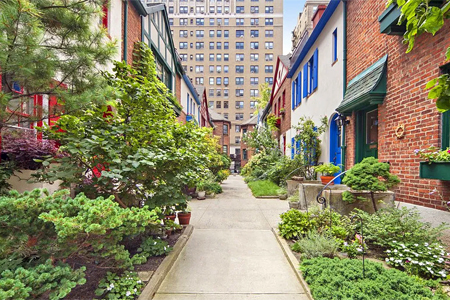
Pomander Walk itself consists of two rows of eight buildings facing each other across a narrow courtyard, all different in style and out of scale with the tall buildings that surround them.
ELIZABETH STREET GARDEN
 owntown, the quiet looks different. Elizabeth Street Garden doesn't feel historic so much as accidental. Classical statues scattered among plants, benches worn smooth by use, sunlight bouncing between old buildings. It feels temporary, even fragile, like it might vanish if too many people agree it's special.
The best time to be there is early, before the day sharpens. Sit for a few minutes. Let the city wake up around you instead of charging straight into it.
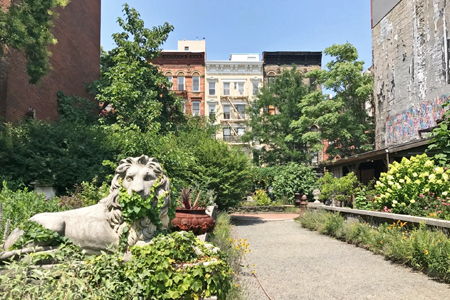
A stone lion, part of a pair, rests in Elizabeth Street Garden, enduring quietly despite repeated threats of eviction and redevelopment.
DITMAS PARK
 rooklyn has its own version of this calm. Ditmas Park isn't a destination you stumble upon by accident; it's a neighborhood you arrive in and immediately feel your pace change. Wide streets. Victorian houses. Trees that make the light dapple instead of harsh.
It doesn't feel curated. It feels inhabited. That's what makes it soothing. Nothing is asking to be photographed. People are just living there.
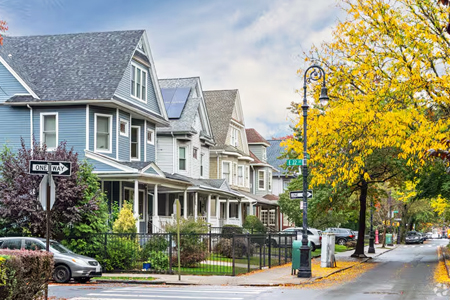
Ditmas Park—tree-lined streets, old houses, and a quiet rhythm far removed from Manhattan.
FORT TRYON PARK AND THE CLOISTERS
 nd then there are places that feel removed not just spatially, but emotionally. Fort Tryon Park and The Cloisters sit high enough above the city that Manhattan feels distant, even abstract.
The gardens are orderly but not stiff. You hear birds more than sirens. The Hudson slips into view at odd angles. You remember that New York is also a landscape, not just an engine.
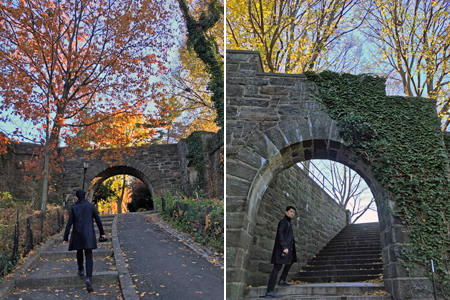
The author approaching the archway and about to ascend the arched steps leading to the Hudson River promenade in Fort Tryon Park.
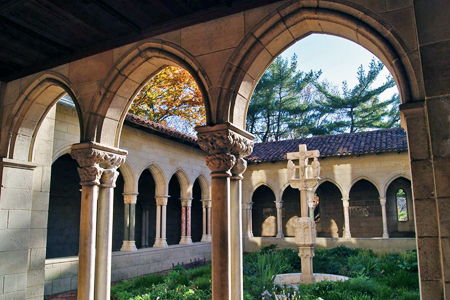
The garden in the inner courtyard within the Cuxa cloister of The Cloisters, the three other main cloister structures being Saint Guilhem, Bonnefont, and Trie.
None of these places are dramatic on their own. That's the point.
They work because they interrupt the expected rhythm of the city. They introduce pauses where you didn't know pauses were allowed. They're reminders that movement doesn't always mean speed. Sometimes it just means changing direction.
This is the version of New York I come back to when the city feels like too much. Not the skyline, not the rush, not the mythology. Just small pockets of quiet that make the rest of it bearable—and, strangely, more impressive. A city that can contain this much stillness inside all that motion earns a different kind of respect.
 ravel writing often chases novelty. New places, new angles, new experiences. But in a city like New York, adventure isn't about discovering something no one's ever seen before. It's about noticing what most people pass without slowing down.
You don't need a map for that. You just need to give the city permission to surprise you.
And it will—softly. (APJ)