
When Coffee Stops Being Just Coffee
 HERE'S A POINT WHERE A SIMPLE HABIT STOPS BEING SIMPLE—not because it changes, but because everything around it starts insisting on a narrative.
Coffee is a good example of that. Probably one of the best.
At its core, it's still just coffee. Beans, water, heat: a process so basic it barely qualifies as technology anymore. And yet somehow it's been turned into a landscape of branding, personality, and carefully staged meaning. You don't just drink it; you're supposed to align with it.
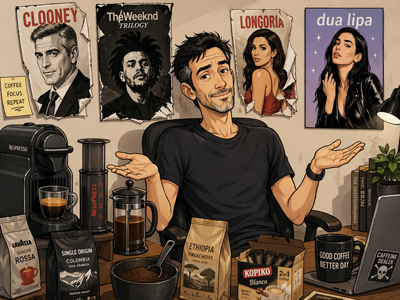
A coffee purist at heart who sticks with Nespresso for the daily ritual—despite side-eyeing the celebrity hype—but can pivot to any brew (or non-brew) method when the moment calls for it. Original AI caricature by the author.
The Nespresso Effect and Celebrity Marketing
 ake Nespresso. It sells itself as convenience, and that part is accurate enough. Capsules, machines, consistency—coffee that shows up the same way every time without asking much from you in return.
But around that mechanical reliability, there's always been a performance layer: glossy boutiques, limited editions, and the idea that coffee is also identity.
And then there are the celebrity endorsements.
It began, for most people's memory of it, with George Clooney—a little too perfectly placed in the whole thing. Then came Eva Longoria, followed by The Weeknd, and now Dua Lipa.
The pattern is obvious: the faces rotate, the tone updates, but the coffee doesn't change.
Why Coffee Marketing Doesn't Really Matter in Practice
That's the quiet contradiction at the center of it all.
The branding evolves constantly, but real coffee decisions almost never happen at that level. They happen in routines, budgets, and habits.
 t a certain point, café coffee becomes a default expense. Starbucks stops being a treat and starts behaving like an unintentional subscription you never really signed up for.
That's where systems like Nespresso make sense—not as luxury, but as control over friction. Predictability. Time saved. Fewer decisions at 7 a.m.
Buying Coffee Outside the Algorithm
Once you're inside that system, marketing becomes background noise.
Buying in bulk from boutiques in Manhattan isn't about lifestyle—it's just cheaper per unit. Retail markups become obvious. Convenience pricing becomes visible. The system kind of reveals itself.
The Manual Coffee Counterbalance
When capsules run out, nothing breaks. The system just shifts.
The AeroPress becomes the quick fallback. The French press slows things down—more body, more time, more attention. The Moka pot sits somewhere in between, when I want something stronger, a bit more old-school, but still not fully committing to a whole ritual.
And then there's the ground coffee rotation: Illy Classico, Lavazza Super Crema, sometimes Dunkin', sometimes Tim Hortons brought back from a recent trip to Banff and left to quietly integrate into daily life.
The Unofficial Layer: Instant Coffee
And occasionally, there are the 2-in-1 instant packets from an Asian grocery on Avenue 2 in Brooklyn—no sugar, no branding ambitions, just function. Coffee stripped down to necessity.
They don't compete with anything. They just exist for mornings where even effort feels like too much.
My Personal Coffee Ecosystem
 t's not really organized at this point, just whatever makes sense in the moment.
Capsules for autopilot mornings. AeroPress when I want a bit more control but still can't be bothered to slow down. French press when I've got time. Moka pot when I want it stronger and a bit more old-school. Ground coffee when I feel like it matters again. Instant packets for the mornings where nothing else is happening yet.
Most days it's not even a decision, just whatever fits the energy.
What Coffee Actually Is
Through all of it, the interesting part is how little marketing affects the lived experience.
 elebrities rotate, branding evolves, campaigns refresh—but real coffee habits don't really move with them. They all settle around one thing: what works.
And in the end, coffee never really became a statement. It stayed what it always was—a small, practical tool for getting through the beginning of the day.
Everything else is just structure built around that fact. (APJ)